Long-form responses
The narrative sections, with a source on every claim
The approach, the methodology, the transition plan, why you and not the incumbent. This page is how a section that is argued rather than answered gets drafted, sourced and signed off.
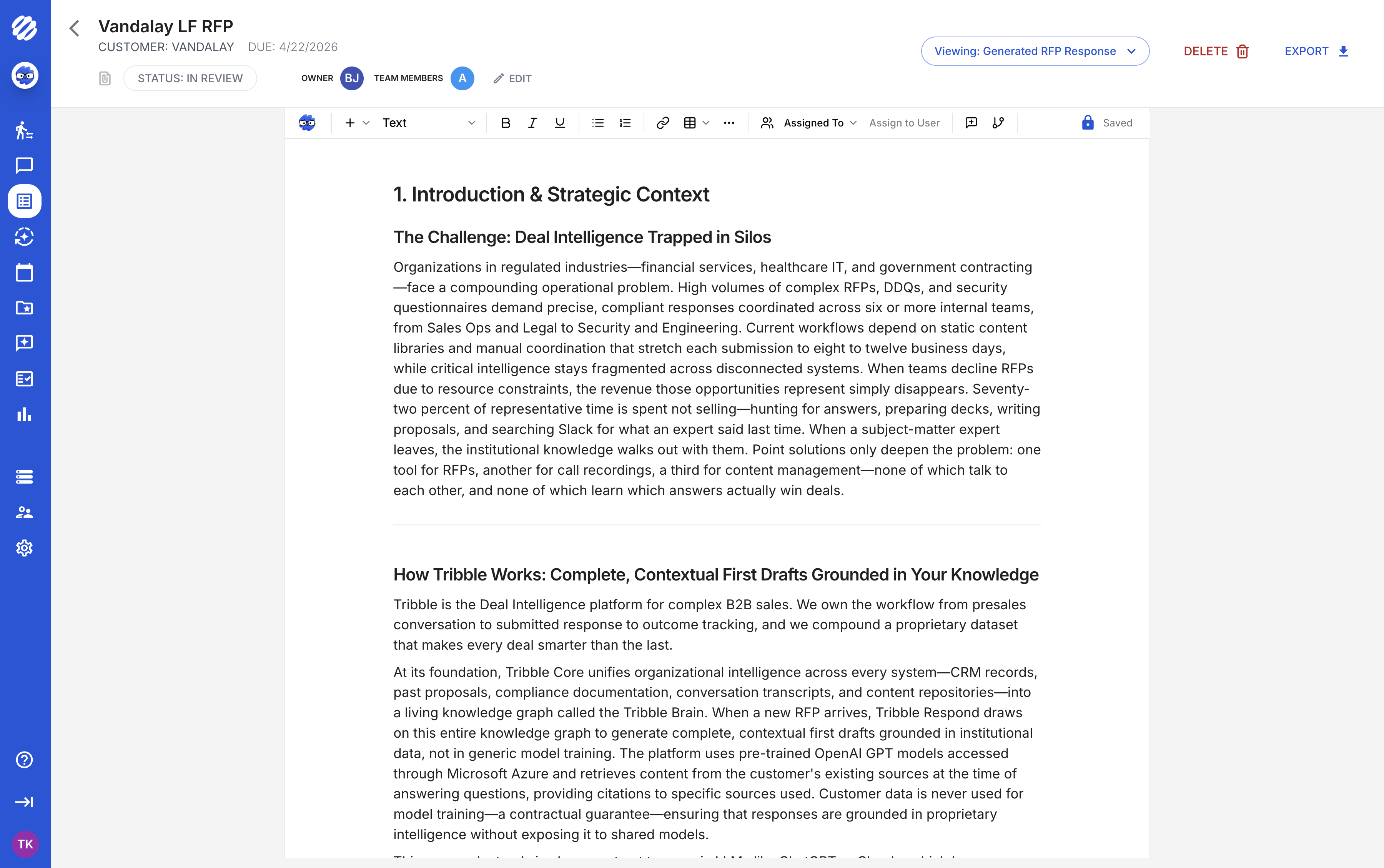
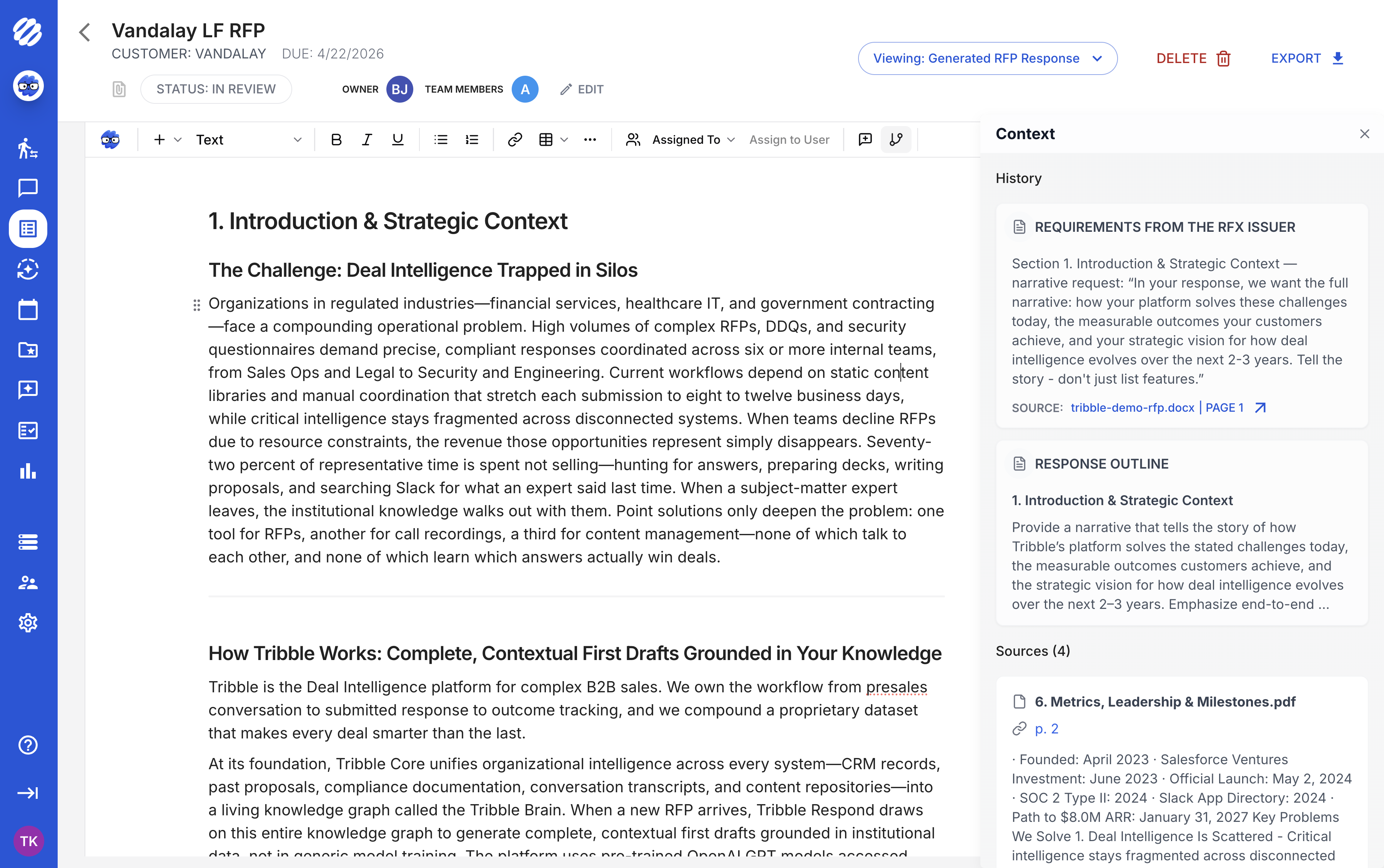
How a narrative answer gets written
Five steps. The argument stays yours. What changes is that every factual claim under it arrives with the document it came from.
- 01
The question that wants prose
An executive summary, a technical approach, a transition plan, a past-performance narrative. Sections that are scored on argument rather than on whether a box is ticked.
- 02
Retrieval, plus the deal
Approved content, previous winning narrative, product documentation and the CRM record for this pursuit. What the buyer said they care about is an input, not an afterthought.
- 03
Drafted with a source on every claim
Each factual claim in the narrative carries the document it came from. The argument is yours; the evidence under it is checkable line by line.
- 04
A named person can reject it
Sections route to the owner who can actually sign off the claim, with the sources beside the draft. Rejecting a paragraph sends it back rather than quietly rewriting it.
- 05
Out in the structure it arrived in
Back into the proposal template, the portal narrative field or the document you were given, with headings, numbering and word limits intact.
What makes a long section reviewable
A questionnaire cell is right or wrong. A narrative section is argued, which is why it needs a different kind of check.
Sourcing per claim, not per section
A citation on a 600-word section tells a reviewer nothing. Each factual statement carries its own document, so a disagreement lands on a sentence.
Ownership per claim
The person who can approve an implementation timeline is not the person who can approve a security claim. A section with both routes to both.
The deal is an input
What the buyer said in discovery, what the CRM records about the competitor, what they scored the incumbent down for. A narrative that ignores all three is a brochure.
Consistent with the grid
The narrative and the question-and-answer cells draw on the same approved content, and the consistency check runs across both. This is the contradiction evaluators find most often.
Nothing unsourced gets written
Where the approved content does not support a claim, the draft marks the gap rather than filling it. A fluent sentence with nothing behind it is the expensive failure here.
Structure survives the round trip
Headings, numbering and word limits come from the document you were given and go back into it. A section written to 500 words comes back inside 500 words.
The same paragraph, drafted two ways
This is the whole argument of the page, so it is worth making in prose rather than in a feature row. Both of these answer the same prompt: describe your implementation methodology.
Our proven implementation methodology is built on decades of combined experience delivering enterprise transformations. We follow an industry-leading phased approach designed to minimise risk and accelerate time to value, underpinned by a dedicated team of certified professionals.
Our customers consistently report rapid adoption and significant efficiency gains, and our best-in-class support model ensures a seamless transition from day one.
Nothing here is checkable. Every clause would survive being moved to a competitor’s proposal, which is the test that matters: if the paragraph works for anyone, it argues for no one.
Implementation runs in three phases over eight to twelve weeks, scoped against the environment survey in section 4.2 of your RFP. Phase one connects the source systems your team already uses and maps review ownership; phase two runs a live workload against that content; phase three widens scope once the first reviewers have signed off.
The comparable deployment is Clari, who reached first production use on the same three-phase sequence and now run 90% of a 200-question RFP in under an hour.
Sources on this draft: Implementation Methodology v4.1 (services), the Clari customer story, and your own RFP section 4.2. A reviewer checks three documents rather than judging the tone.
What it writes into
The narrative goes back into the thing you were given, not into a text box you then have to reformat.
The sections that get scored on argument
Each of these is marked by a human reading for a reason to prefer you. The failure mode is different in every one.
Executive summary
"Summarise your understanding of our requirement and why your proposal represents the best value."
Drafted from what the buyer actually said in discovery and what the CRM records they scored the incumbent down for, rather than from your capability statement. It is the only section some evaluators read in full, and the only one where the argument has to land before the evidence.
What reads as boilerplate Written last, from the rest of the proposal, which produces a summary of you rather than an answer to them.
Technical and solution approach
"Describe your proposed solution and how it meets each of the requirements in Annex A."
Mapped claim by claim to the requirement it answers, drawing on current product documentation. Each capability statement carries the document behind it, so a reviewer checking against Annex A finds a reference rather than a paragraph.
What reads as boilerplate A solution narrative that reads well and never explicitly answers four of the twenty requirements.
Implementation and transition plan
"Set out your implementation plan, including timescales, resourcing and your approach to transition from the incumbent."
Drafted from the methodology services actually runs, with the timeline routed to the person who has to hit it. Transition is the part incumbent-displacement deals are won on and the part most often answered generically.
What reads as boilerplate A plan the proposal team wrote and delivery has never seen, which becomes a contract schedule.
Past performance and references
"Provide three engagements of comparable scope and describe the outcomes delivered."
Matched on actual comparability, from the customer record rather than from the three stories everyone reaches for. The outcome figures come from the published story, so they match what a reference call will say.
What reads as boilerplate Three references chosen for logo recognition rather than for resembling this buyer’s problem.
Risk and mitigation
"Identify the principal risks to delivery and describe your mitigation for each."
Drawn from what actually went wrong on comparable engagements and what was done about it. A credible risk register names risks that are genuinely yours, which is what distinguishes it from a list of generic project risks.
What reads as boilerplate Risks written to be reassuring, which signals to an experienced evaluator that you have not run this before.
Why us, against the incumbent
"Explain what differentiates your proposal from alternative providers, including the current supplier."
Built from the competitive record and what this buyer has already said is not working, with claims about your own capability sourced. Claims about a competitor are left to the deal team, because an unsourced claim about someone else is the one that gets challenged.
What reads as boilerplate A differentiation section that describes your strengths without once engaging with why they are still with the incumbent.
Responses that consumed a week now land in hours
The numbers below are from response teams running this workflow on their own content.

How this differs from the three usual ways it gets done
Narrative work has its own alternatives, and none of them is an answer library.
| Tribble Respond | A boilerplate template | A proposal writer from scratch | ChatGPT or Claude | |
|---|---|---|---|---|
| Where the prose comes from | Approved content plus this deal’s record | Last year’s submission, lightly edited | The writer, plus whoever answers their questions | The prompt, plus the model’s priors |
| Claims carry a source | Per claim, in the draft | Whatever the original had | Only if the writer chases each one | No way to tell what was read |
| Tailored to the buyer | Discovery notes and CRM context are inputs | Find and replace on the customer name | Yes, if the writer has the context | Only what you paste in |
| Unsupported claims | Marked as a gap rather than written | Carried forward unexamined | Flagged when the writer notices | Written fluently and indistinguishably |
| Consistent with the grid | Same content, checked across both | Two documents, two sources of truth | Manual cross-read at the end | Unaware the grid exists |
| Time to a first draft | Minutes, then editing | Fast, and it reads like it | Days, and it reads well | Minutes, then fact-checking |
| Who it still needs | An editor and the claim owners | Someone to notice what is stale | A writer, and every SME they chase | Someone to verify every sentence |
The questions a proposal writer asks
Not the objections a vendor prepares for. The ones that decide whether this touches the sections that matter.
"Writing is the part I am good at. What is left for me?"
The argument, the emphasis and the structure, which is the part that wins. What goes is assembling the facts underneath it and chasing six people to confirm them. The draft arrives with the evidence already attached, which is the research half of the job rather than the writing half.
"AI prose reads like AI prose."
Often, yes, and a first draft here still reads like a first draft. The difference is what it is drafted from: your previous winning narrative rather than a general register. The real tell in bad proposal prose is unsupported confidence, and that is the specific thing a sourced draft cannot do.
"Our sections have hard word limits."
Limits come through from the document and the draft is written inside them. A 500-word section comes back under 500 words, with the sources carried separately rather than eating the count.
"The narrative always ends up contradicting the matrix."
That is the failure this is built for. Both draw on the same approved content and the consistency check runs across the narrative and the grid together, before submission rather than after an evaluator reads both.
The pattern across all four: the claim is not that this writes better than a proposal writer. It is that a sourced draft can be checked in an afternoon and an unsourced one cannot be checked at all.
Where it reads from
The content stays where it is. Permissions come with it.




Questions that come up on long-form work
The ones asked on nearly every call.
Can AI write the narrative sections of a proposal?
It can draft them, and the question that matters is whether the draft is checkable. Tribble drafts narrative sections from approved content and the deal record, and attaches the source document to each factual claim, so a reviewer verifies the evidence rather than judging whether the prose feels right. The argument and the emphasis stay editorial decisions; what is automated is the assembly and the sourcing.
How is this different from asking ChatGPT to write an executive summary?
A general-purpose model will write a fluent executive summary from whatever is in the prompt, and nothing in the output distinguishes a claim it read from a claim it inferred. Tribble will not write an unsourced claim into a narrative section: where the approved content does not support a statement, the draft says so rather than filling the gap. That is the difference between a draft you edit and a draft you have to fact-check.
Does it sound like us, or like AI?
It drafts from your previous winning narrative, so the register is taken from your own writing rather than from a house style setting. The honest answer is that a first draft still reads as a first draft and a proposal writer still edits it. What changes is that the editing is about argument rather than about assembling facts.
What about word limits and formatting?
Section limits, headings and numbering are carried through from the document you were given, and the export goes back into the same structure. A section written to a 500-word limit comes back inside it.
Which sections does this work best on?
Executive summaries, technical and management approaches, implementation and transition plans, past-performance narratives, and the written parts of a security or diligence response. Anywhere the answer is argued rather than stated.
Can reviewers see what a claim was drafted from?
Yes. Each claim carries its source document, and the sources sit beside the draft in the editor rather than in a separate report. A reviewer who disagrees with a claim can see immediately whether the problem is the source or the sentence.
Does it stay consistent with the question and answer sections?
It draws on the same approved content as the questionnaire and RFP grids, and the consistency check runs across the whole response. A narrative that contradicts a cell in the technical matrix is exactly the failure this is built to catch.
How does pricing work?
Annual platform editions based on response volume, included projects and enterprise requirements. The pricing page carries the current structure.
Read next
The other response workflows this runs on.
RFP automation
The grid sections, answered from the proposals you have already won.
Security questionnaires
SIG, CAIQ, VSA and a buyer’s own spreadsheet.
DDQ automation
Investor and operational due diligence, answered from fund documentation.
Portal and chat intake
Questions answered where they are asked, in Slack, Teams or a portal.
How TaskUs did it
Responses that consumed a week, landing in hours.
Tribble Respond
The product all five workflows run on.